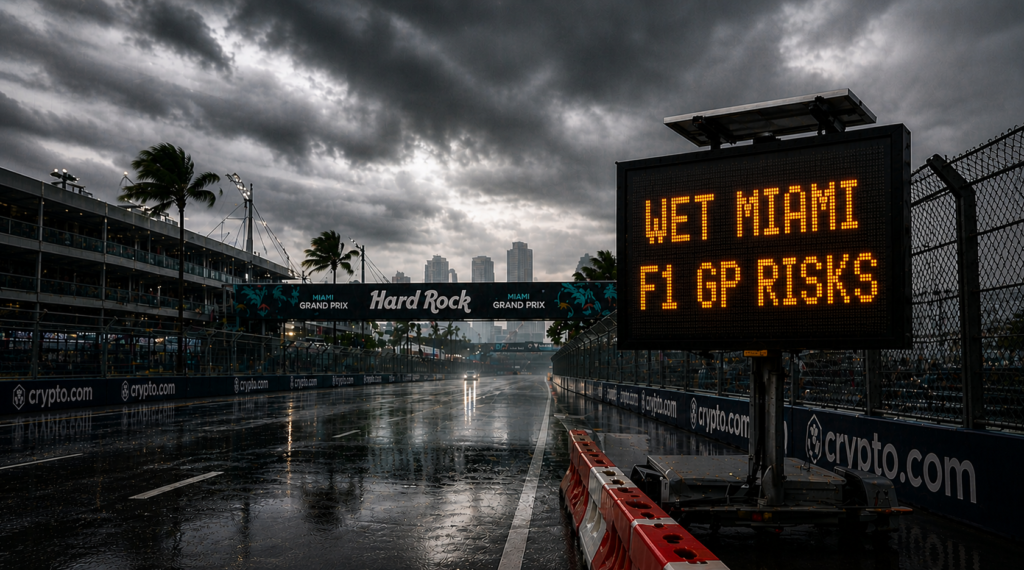
Why a Wet F1 Miami GP Could Be So Tricky for Drivers and the FIA
Formula 1 in Miami already has a reputation for heat, glamour, speed, and tight margins. But if rain hits the Miami Grand Prix, the race could turn into something much more unpredictable.
The concern is not just that the track may become wet. The real issue is that Miami could become one of the first major tests of F1’s new-generation 2026 cars in wet racing conditions. That means teams, drivers, tyre suppliers, and the FIA may all be dealing with unknowns at the same time.
The Miami International Autodrome is a temporary circuit around the Hard Rock Stadium complex. It has 19 corners, a 5.41 km layout, and several high-speed sections, which already makes it demanding in dry conditions. In the rain, those same features could become a serious challenge.
Why Rain in Miami Is Not a Simple Problem
Rain in Formula 1 is always dramatic, but Miami brings its own complications.
The track is built around a stadium and parking-lot-style surface areas. That matters because drainage can become a major issue when heavy rain arrives. If water does not clear quickly, drivers may face standing water, lower visibility, and a higher risk of aquaplaning.
According to Motorsport.com, drivers have already raised concerns about how water may sit on the surface in Miami, especially because the circuit is very flat. Max Verstappen also pointed to standing water seen during previous Miami running, while Carlos Sainz highlighted the danger of water staying on the straights with walls close by.
This is where the race becomes complicated for the FIA. A wet track can still be raceable. But if lightning, severe rain, or unsafe visibility comes into play, officials may need to delay, red flag, or neutralise the session.
The FIA’s Biggest Concern: Disruption, Not Cancellation
There has been talk about whether bad weather could stop the Miami GP completely. But based on the FIA’s position reported by Motorsport.com, cancellation is not the main expectation right now. A delay or red flag appears more likely if thunderstorms affect the event.
That is important for fans to understand.
A wet Miami GP does not automatically mean the race is off. It means race control may need to manage the event carefully. If lightning is close to the circuit, people may need to take shelter. If there is too much standing water, cars may be kept in the pit lane until conditions improve.
In simple terms: the FIA wants the race to happen, but only if it is safe enough.
The 2026 F1 Cars Add a New Layer of Risk
The biggest reason this wet Miami GP could be so tricky is the timing.
F1 is now dealing with the 2026 regulation era, which includes major changes to power units, aerodynamics, and energy deployment. Formula 1 has described the 2026 cars as having active aerodynamics, narrower tyres, and a power unit philosophy that moves closer to a 50:50 split between combustion and electric power.
That changes how the cars behave.
In wet conditions, drivers need confidence. They need predictable grip, smooth power delivery, and clear visibility. But with new cars, new systems, and new rules, the teams may not yet have enough real-world wet-weather data.
That is why Miami could become a genuine stress test.
MGU-K Deployment and Boost Mode Could Be Critical
One major technical concern is electric power deployment.
Under the updated 2026 rules discussed ahead of Miami, the FIA can limit MGU-K deployment in low-grip conditions. Motorsport.com reported that boost mode is banned in such conditions, and Kimi Antonelli mentioned that power could be clipped for wet running.
This matters because too much sudden electric power in the rain can make the car harder to control.
A Formula 1 car already produces huge torque. Add a wet surface, cold tyres, and limited grip, and the driver has to manage every throttle input with extreme care. If the rear tyres spin too easily, the car can snap sideways before the driver has time to react.
So the FIA’s intervention is not just a technical detail. It is a safety move.
Active Aerodynamics Could Be Another Big Question
The 2026 cars also bring active aerodynamic systems, replacing the old DRS-style thinking with movable front and rear aero elements. Formula 1 has described active aerodynamics as a way to switch between high and low downforce configurations.
In dry weather, that can help efficiency and overtaking.
In wet weather, it becomes more delicate.
Motorsport.com reported that Carlos Sainz questioned the idea of partial active aero in low-grip conditions, especially if the benefit is small compared to the potential risk. The FIA’s updated rules allow only partial activation of driver-adjustable bodywork in low-grip zones, with rear active aero restricted.
That raises a simple question: how much aero movement is safe when grip is already limited?
If the balance of the car changes at the wrong moment, especially on a wet straight or braking zone, drivers may lose confidence quickly.
Tyre Temperature May Decide Everything
In wet Formula 1 races, tyre temperature is often the difference between control and chaos.
If the tyres are too cold, the car slides. If the driver slides too much, the tyres may never enter the correct working window. That creates a vicious cycle.
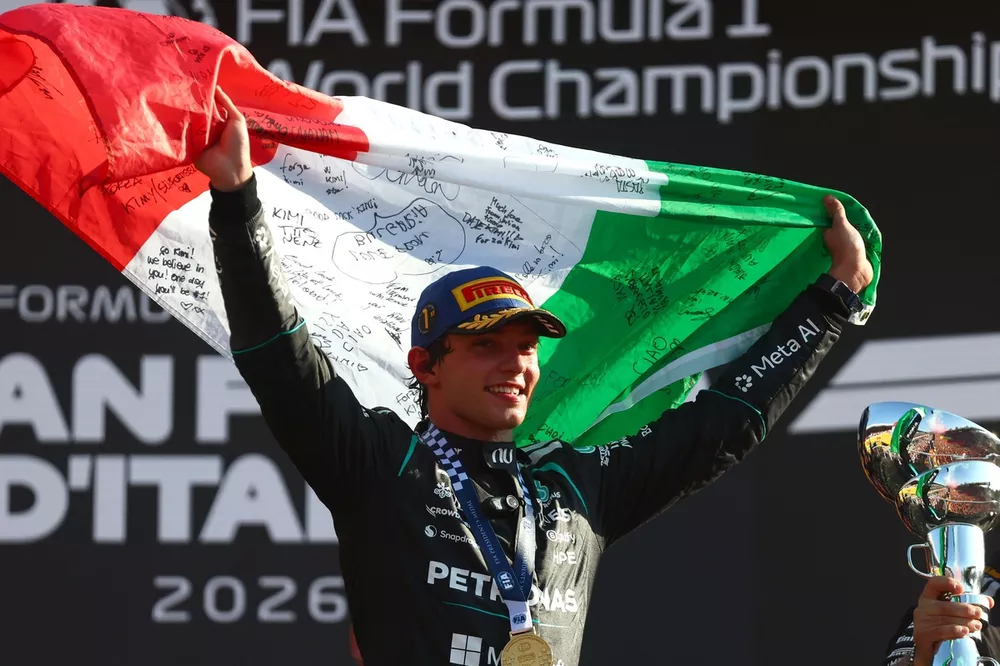
Kimi Antonelli raised this exact concern, pointing out that wet-weather tyre blanket temperatures may need to be higher to improve initial grip. Motorsport.com also reported that the FIA increased tyre blanket temperatures for intermediates after driver feedback.
This is a crucial point.
Miami may be warm as a city, but a wet circuit can still make it difficult to generate tyre temperature. When cars have less cornering downforce and less grip, the tyres may not load up in the same way. That means drivers could struggle most on out-laps, restarts, and safety car periods.
And in a race with rain, those moments are usually where mistakes happen.
Visibility Could Be a Serious Safety Issue
Modern F1 cars throw up a huge amount of spray in wet conditions. When one car follows another, the driver behind can lose almost all visibility.
Now add Miami’s long straights, close walls, and potential standing water.
That combination is dangerous because a driver may not see braking points, puddles, or a car slowing ahead. Even if the track is technically raceable, visibility may become the deciding factor.
This is why race control often waits longer than fans would like during wet races. From the outside, it may look like drivers should be able to race. From inside the cockpit, the view can be almost blind.
Why Miami’s Layout Makes Wet Racing Harder
The Miami International Autodrome is not a traditional permanent racing circuit. It is a temporary venue designed around the Hard Rock Stadium area, but with a permanent-feeling layout. Formula 1 notes that the circuit was selected after many layout simulations and features a 19-turn lap around the stadium complex.
That gives Miami a unique character.
But in the rain, the same layout can become difficult because:
The track is flat. Water may not run away quickly.
There are high-speed sections. Standing water on straights can create aquaplaning.
Walls are close in places. A small mistake can become a big crash.
Grip levels can change corner by corner. Temporary circuits often evolve quickly during a weekend.
This means the drivers are not only racing each other. They are also reading the surface every lap.
Could a Wet Miami GP Be Exciting? Absolutely
Despite the risks, a wet Miami GP could also create one of the most exciting races of the season.
Rain reduces predictability. It rewards brave drivers, smart strategy calls, and quick reactions from the pit wall. A well-timed switch from full wets to intermediates, or from intermediates to slicks, could change the entire race.
Wet races often create surprise podiums because raw car pace becomes less dominant. Driver feel, tyre management, and timing become just as important.
That is why fans love rain.
But the show only works if the conditions are safe enough.
What the FIA Must Get Right
For the FIA, the Miami GP could become a major operational test.
They will need to judge:
Whether lightning creates a safety risk for fans, marshals, teams, and drivers.
Whether standing water is too dangerous.
Whether visibility is acceptable.
Whether the 2026 car systems behave safely in low-grip conditions.
Whether tyre temperatures are manageable during race starts and restarts.
These calls are never easy. Start too early, and safety becomes a concern. Wait too long, and fans get frustrated. But in modern F1, especially with new regulations, the FIA cannot afford to guess.
Final Thoughts: Miami Rain Could Turn the Race Into a Real Test
A wet F1 Miami GP would not just be another rainy race. It could become a major test of the 2026 Formula 1 era.
The combination of new cars, active aerodynamics, electric deployment limits, tyre temperature concerns, standing water, and Miami’s flat circuit layout makes this a uniquely tricky situation.
The FIA appears confident that cancellation is unlikely, but disruption remains possible if thunderstorms or unsafe track conditions arrive.
For fans, the message is simple: if rain hits Miami, expect drama.
For drivers, the message is even simpler: stay sharp, keep the tyres alive, and trust nothing until the chequered flag.