
Norris wins the São Paulo Sprint in a dramatic race filled with crashes, pressure, and changing conditions. Explore the full story with ”.
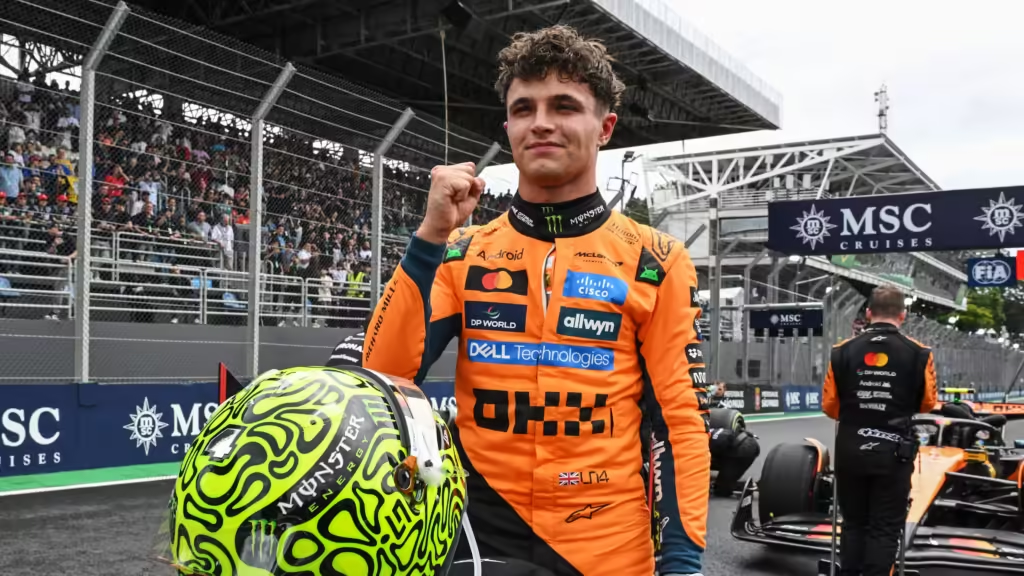
Lando Norris once again rose to the moment at the São Paulo Grand Prix, winning a dramatic and unpredictable Sprint that tested the nerves of every driver on the grid. It was one of those races where you could almost feel the tension through the screen, where every lap felt like a coin toss between triumph and disaster. And somehow, through slippery kerbs, mounting tyre wear, and relentless pressure from Kimi Antonelli, Norris held firm.
Before we explore how the championship leader extended his advantage in a chaotic 24-lap dash, here’s a quick guide to what you will find in this article.
A High-Pressure Sprint with a Calm Beginning
Like a storm waiting to break, the São Paulo Sprint opened quietly. Most drivers opted for medium tyres, though the likes of Antonelli, Russell, and Verstappen gambled on the softs. With the track still patchy from earlier showers, everyone knew grip would be inconsistent—almost like walking on a tiled floor with wet shoes. You think you’re steady until suddenly you’re not.
Norris Launches Cleanly as Antonelli Defends Early
When the lights went out, Norris executed a flawless start, pulling ahead without even a hint of wheelspin. Behind him, Antonelli had his hands full keeping Oscar Piastri behind. Verstappen had a sharper launch and cleared Alonso to climb towards the front.
For a brief moment, the race looked predictable: leaders settling into rhythm, gaps forming, strategies playing out normally. But Interlagos never keeps things calm for long.
The Field Sorts Itself Out—But Not for Long
Within four laps, Norris had built a gap of nearly 1.5 seconds. The top five looked steady, but the midfield was a battleground. Alonso, Leclerc, and Hamilton engaged in a tense three-car chain where every corner looked like a setup for an overtake.
That tension snapped on Lap 6.
The Turn 3 Domino Effect: Piastri, Hulkenberg & Colapinto Crash
Piastri misjudged the damp kerb at Turn 3, slid wide, and smashed into the barriers. Before the yellow flags fully stabilized the situation, Hulkenberg and Colapinto skated off at the same spot—victims of water dragged back onto the racing line.
The triple incident forced the Safety Car and, moments later, a red flag. Piastri’s day was over, and with it, his chance to defend his narrow championship margin to Norris.
A Critical Red Flag That Reshaped the Race
During the pause, every team faced the same question: how would the restart look on a track that continued evolving with every passing minute? Soft tyres became the popular choice, adding another layer of intrigue.
Hulkenberg’s team managed to repair his car in time—a small victory in the middle of chaos.
The Rolling Restart: Norris Retakes Command
With 15 laps left, the Safety Car peeled in. Norris immediately bolted, timing his launch perfectly to maintain the lead. Antonelli fended off Russell, setting the stage for a gripping two-way fight at the front.
Behind them, Alonso nearly caught Verstappen napping but ultimately had to settle back into position.
Mid-Race Battles That Kept Everyone Guessing
The next few laps were a masterclass in defensive driving. Alonso, Leclerc, and Hamilton continued their intense but respectful duel. Gasly closed in on Stroll, creating a four-car train for the final points.
Even though the leaders were in clean air, the tension remained constant across the field.
Ferrari vs Aston Martin: A Duel of Patience and Pressure
Alonso’s team asked him to lift and coast, but Leclerc didn’t ease off. He studied Alonso corner after corner—like a chess player waiting for one wrong move. When the door finally opened, Leclerc slipped through to claim fifth.
Hamilton quickly applied pressure next, pushing Alonso further onto the defensive.
Norris’ Tyre Trouble Becomes Antonelli’s Opportunity
While everything unfolded behind him, Norris had a new problem: rear-tyre degradation. The softs were fading quickly, and Antonelli started closing the gap dramatically.
By Lap 20, the margin had shrunk to 0.4 seconds. Suddenly, Norris’ win looked anything but guaranteed.
Bortoleto’s Heavy Crash and a Neutralized Finish
Just as Antonelli prepared his decisive attack, home favourite Gabriel Bortoleto crashed heavily into the barriers. Thankfully, he reported he was unhurt. The incident triggered double yellow flags as the final lap began.
How Norris Secured Victory Under Double Yellows
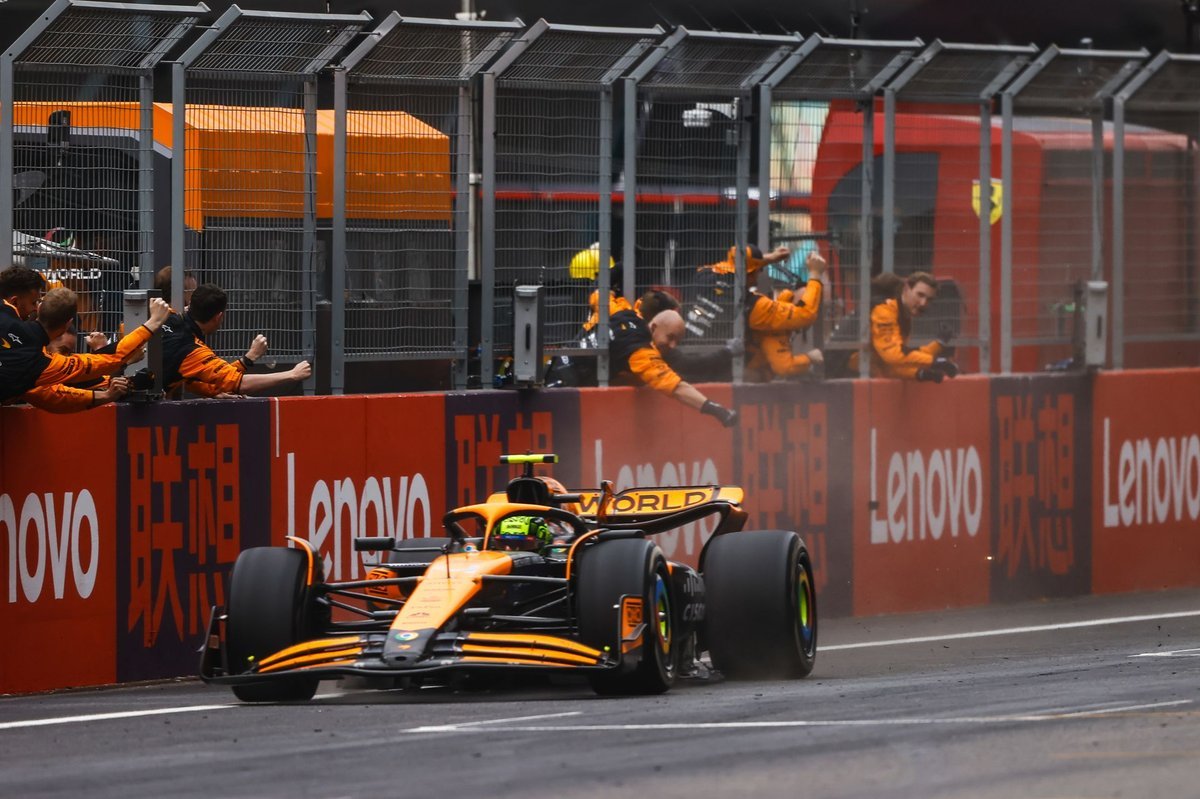
With overtaking prohibited, the final lap became a controlled march to the line. Norris held his position, crossing the finish 0.845 seconds ahead of the charging Antonelli.
In a race full of twists, timing was everything—and the yellow flags arrived at exactly the right moment for the McLaren leader.
The Points Picture: A Major Boost for McLaren’s Leader
Norris extended his championship advantage to nine points, taking crucial momentum into Sunday’s Grand Prix. Antonelli and Russell completed the podium, while Verstappen salvaged fourth to stay in mathematical contention.
Midfield Drama: Penalties Shake Up the Order
Incidents between Bearman and Lawson earned both drivers five-second penalties. Their infractions—and Lawson’s post-race demotion—shifted several midfield positions.
Weather Uncertainty and Tyre Choices Before the Sprint
The pre-race debate over tyre compounds, damp patches, and pit-lane starts for Tsunoda and Sainz all contributed to the unpredictability of the race.
A Look at the Final Classification
Norris, Antonelli, Russell, Verstappen, Leclerc, Alonso, Hamilton, and Gasly secured the points. Stroll, Hadjar, Ocon, Bearman, Tsunoda, Sainz, Hulkenberg, and Albon rounded out the finishing order, with Piastri, Bortoleto, and Colapinto as the retirees.
Conclusion
The São Paulo Sprint was everything a short-format race should be—high-energy, mistake-punishing, and filled with storylines. Norris showed championship composure, Antonelli revealed maturity beyond his years, and Interlagos reminded the world why it remains one of the most unpredictable circuits on the F1 calendar. If the Sprint is anything to go by, the Grand Prix promises even more drama.
FAQs
1. Why was the São Paulo Sprint red-flagged?
The red flag was issued after Piastri, Hulkenberg, and Colapinto all crashed at Turn 3 due to damp conditions and water dragged onto the track.
2. How did Norris defend against Antonelli’s late challenge?
Despite heavy tyre wear, Norris positioned his car well and benefited from double yellow flags after Bortoleto’s crash, preventing overtaking on the final lap.
3. Why did Piastri crash early in the Sprint?
He touched the wet kerb at Turn 3, which caused a loss of grip and sent him into the barriers.
4. Which drivers started from the pit lane?
Yuki Tsunoda and Carlos Sainz started from the pit lane due to changes made under parc fermé conditions.
5. How many points does the Sprint winner receive?
The Sprint winner receives eight points, with points awarded down to eighth place.